-Karthik Gurumurthy
Helsinki Cathedral

Today we began at Helsinki Cathedral, standing proudly over Senate Square in the Kruununhaka neighbourhood. Built between 1830 and 1852 as a tribute to Grand Duke Nicholas I of Russia, the church was originally known as St Nicholas’s Church until Finland gained full independence in 1917. Designed by Carl Ludvig Engel as the centrepiece of his Senate Square design, the neoclassical cathedral is instantly recognizable by its tall green dome, ringed by four smaller domes. We admired how the building forms a Greek cross in plan, with a square centre and four equal arms, each front lined with columns and topped with a pediment.
Uspenski Cathedral

From there, we walked over to Uspenski Cathedral, the main cathedral of the Orthodox Church of Finland and the largest Orthodox church in both Northern and Western Europe. Dedicated to the Dormition of the Theotokos, the cathedral takes its name from the Old Church Slavonic word for that feast. We learned that after Helsinki became Finland’s capital in 1812, Tsar Alexander I decreed in 1814 that a share of the salt import tax be set aside to fund two new churches, one Lutheran and one Orthodox. As Helsinki’s Orthodox parish grew, so did the need for a bigger church, and the cathedral was largely funded by parishioners and private donors. Designed by Russian architect Aleksey Gornostayev, it was built between 1862 and 1868, after his death, under the direction of architect Ivan Varnek, and was inaugurated on 25 October 1868.
Kanavapuisto Park
From there, we wandered over to Kanavapuisto Park, designed by Helsinki’s first city gardener, Svante Olsson, and completed in the early 20th century. Covering 2,400 square metres, the park is part of a nationally notable built environment. Olsson had designed it with variety in mind, weaving together distinct types of spaces to surprise and delight visitors, while placing great emphasis on the views out from the park and the diversity of plant life within it. A staircase in the park leads up to Uspenski Cathedral, the main church of the Orthodox Parish of Helsinki and the Orthodox Church of Finland. Since much of the park’s vegetation is original and delicate, we made sure to stay on the marked paths and treat the space with care.
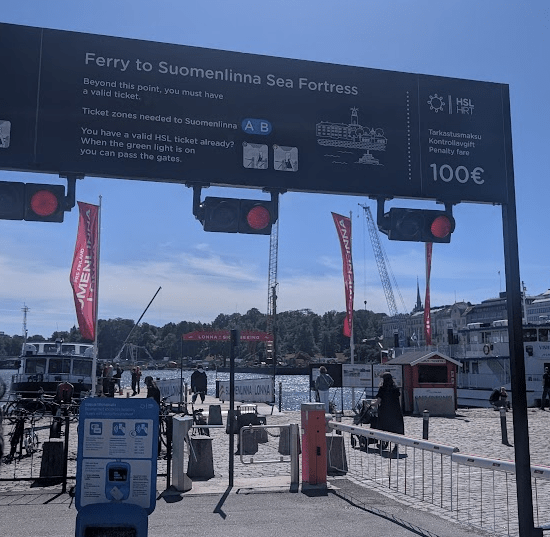
From there, we made our way to Suomenlinna Sea Fortress. This stunning UNESCO World Heritage site spans a group of islands off the coast of Helsinki, Finland.
Great Courtyard
We stood in the Great Courtyard, designed by the fortress’s founder, Augustin Ehrensvärd, and completed in the 1760s as Suomenlinna’s main square. It was badly damaged during the Crimean War in 1855, but today it holds an impressive memorial to Ehrensvärd himself, the architect behind the whole fortress.
Dry Dock
We made our way to the dry dock, one of the oldest operational dry docks in the world. In the 1760s, ships for the Swedish naval fleet were built here under the supervision of naval architect F. H. af Chapman. Today, we learned, the dock is used to restore old sailing boats.
Jetty Barracks
We found ourselves standing in the pink-plastered Jetty Barracks, the main gateway to Suomenlinna’s Russian period. Originally the fortress’s main guard house, the building now holds the tourist information office, the Suomenlinna Brewery restaurant, and the Jetty Barracks Gallery, run by the Helsinki Artists’ Guild.
Suomenlinna Church
We visited the church, built in 1854 as a Russian Orthodox garrison church and later converted into a Lutheran church in the 1920s, once Finland took control of the island. We noticed a working lighthouse still operating from the steeple, guiding both air and sea traffic. It flashes four short signals, which in Morse code spell the letter H, for Helsinki.
Kustaanmiekka
At Kustaanmiekka, we could see both the original bastion and a Russian coastal defense line built in the late 1800s, complete with sand embankments and artillery points. From here, the sea views stretched all the way to the mainland, and we took a moment just to take it all in.
King’s Gate
We ended our walk at the King’s Gate, Suomenlinna’s most iconic landmark. Built between 1753 and 1754 as a ceremonial entrance, it marks the spot where a ship carrying King Adolf Frederick of Sweden, the fortress’s founder, once anchored while he inspected the construction.
 Striving Towards Excellence
Leave a comment